
25 Apr, 2026 | Buy Fenbendazole | No Comments
Fenbendazole and Immunotherapy: Can They Work Together?
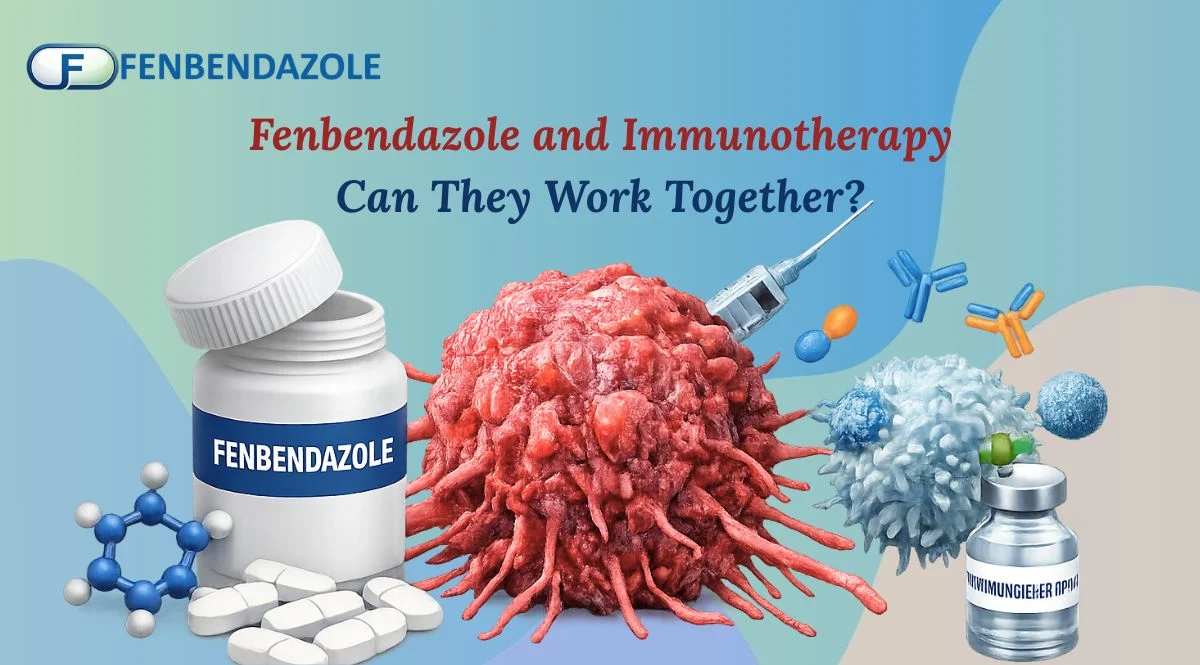
Cancer therapies change and grow alongside our understanding of cancer biology. Some therapies combine standard approaches with other methodologies. An example of this is the potential combination of fenbendazole and immunotherapy. Complementary potential of these therapies is still mostly theoretical and experimental.
Used primarily for as an antiparasitic, fenbendazole has become of interest as a potential cancer therapy. Immunotherapy has revolutionized cancer therapies and assists the patient’s acquired immune system in recognizing and attacking a cancer’s unique antigens.
So, can fenbendazole and immunotherapy work together? Providing no clinical evidence, researchers hypothesize the outcome of this combination.
Key Takeaways
- Fenbendazole, in preclinical studies, has shown anticancer potential.
- Cancer Immunotherapy is a therapy that helps the body ramp up its immune system.
- The theories in the research suggest fenbendazole and immunotherapy work well together.
- The theories currently support a treatment that has yet to have a strong clinical base.
What Is Fenbendazole and Why Is It Being Studied?
Fenbendazole has classically been used as a benzimidazole antiparasitic for animals. Recent literature reviews provide theories of fenbendazole’s cancer biology.
Along with the aforementioned theories, fenbendazole was found to disrupt cancerous microtubules, a unit of a cycling structural unit of a cellular architecture. With the help of fenbendazole, the growth of these structures would theoretically begin to lessen.
Researchers study fenbendazole’s potential effects on metabolic processes in cancers. Many cancer types have a high glucose dependence fueling their energy needs. Tumors can utilize slightly modified metabolic circuits. Fenbendazole has a strong interest here in addition to combined approaches of fenbendazole and immunotherapy.
These findings result from laboratory and animal case studies and have yet to be established with human cancer amendments.
How Immunotherapy Works
Immunotherapy significantly differs from chemotherapy and radiation. Unlike both, it intensifies the body’s defense system. It teaches the body to detect and engage with cancer.
Many of the types are listed below:
Checkpoint Inhibitors
Drugs in this category remove the “brakes” that cancers have employed to slow the body’s immune system.
CAR T-Cell Therapy
This makes adaptive, flexible, and long-term memory immune response against cancer.
Cancer Vaccines
These stimulate immune responses against cancer.
Immunotherapy represents a complex and involving approach to cancer, and researchers have suggested fenbendazole and immunotherapy might work together.
Why Researchers Are Exploring Fenbendazole and Immunotherapy Together
The combined interest in immunotherapy and fenbendazole derives from the theory of reducing the strength of cancer cells and prompt the immune system
If fenbendazole is proven to weaken tumor cells, then immunotherapy should potentially work more effectively, and is more likely to show positive results.
Researchers have established various hypotheses pertaining to fenbendazole and immunotherapy:
Enhanced Treatment Effect
Researchers believe that the combined immunotherapy and fenbendazole will increase the chances of a positive patient outcome (further demonstrating) than either treatment will alone.
Potential to Overcome Resistance
Immunotherapy can be ineffective if used consistently over longer period.
These are just a few examples of the significant innovations fenbendazole with immunotherapy could provide.
Tumor Microenvironment Support
Some scientists say fenbendazole has the potential for influencing the tumor microenvironment in a way that supports immune activity, but that thing is still being studied.
There has been a rising interest for fenbendazole and immunotherapy because it goes on speculation, but it is still fundamentally set on providing the support of the clinical trials.
What Does Early Evidence Say?
So far, the evidence for fenbendazole and immunotherapy is stemmed from:
- Laboratory
- Animal
- Preclinical cancer models
- Anecdotal
The studies claim fenbendazole may:
- Slow the growth of cancer cells
- Lead to programmed death of cancer cells
- Alter metabolism of cancer cells
- Make cells more susceptible to other therapies
There is no strong evidence that fenbendazole and immunotherapy used altogether may be called the fight against cancer.
Challenges and Possible Risks
There are yet some interesting points to address.
Limited Human Data
Direct clinical evidence, if fenbendazole and immunotherapy are used, is insufficient to support this theory.
Unknown Drug Interactions
There may be combination of fenbendazole and immunotherapeutic agents with the oppositional untreated cancer remains an enigma.
Regulatory Concerns
Fenbendazole remains in the detentions of not treating adults with improvised cancer therapy, thus allowing the complexity to remain in the absence of surpassing derelicts.
Individual Variation
Cancer is a consequence of a great variety of biology.
To this end, fenbendazole and immunotherapy should leave the research of practice.
Future Research Directions
Interest in fenbendazole and immunotherapy has opened several important research questions.
Potential studies may investigate:
- The action of ndazoleon immune; and yet there is a mystery to being unduly a paper with their certain fenbendazole.
- Only well-planned clinical trials can help develop tests evaluate safety, dosing, and efficacy.
- Are fenbendazole, alone, or in combination with other treatments, effective in combination with other therapies and/or immunotherapeutic treatments toward resistant cancers.
- Biomarkers may ultimately resolve some of the questions as to which, if any, patients would stand to benefit from fenbendazole and immunotherapeutic combination strategies.
What Patients Should Keep in Mind
If a combination therapy piques your interest due to their unconventional nature, please be aware that cancer-related choices are highly personal.
Consequently, fenbendazole and immunotherapy ought to be treated as a novel interdisciplinary approach.
If you are looking for complementary integration strategies, you should:
- Talk to your oncology team
- Look into the possible interactions and risks
- Investigate claims that lack scientific credibility
- Use medicine that is based on fact
If you are taking this combination under medical supervision, please be aware of the scientific interest in this area that is increasing rapidly.
Conclusion
The focus on combining fenbendazole with immunotherapy underscores the interest in developing novel approaches to cancer treatment.
Relatively primitive research has revealed that there are scientific rationales for treating cancers with one treatment modality to disrupt the cancer cell and the other to fortify the immune response.
Much research will be needed to prove the pairing of fenbendazole and immunotherapy.
This will be the primary focus for researchers hoping to develop novel approaches to treating cancers with the use of fenbendazole and immunotherapy combinations. This will be complemented by novel approaches to treating fenbendazole in immunotherapy.
It is in the cancer science field that positive research will be situated, but in practices it will be negligible.
Write Reviews
Leave a Comment
No Comments & Reviews