
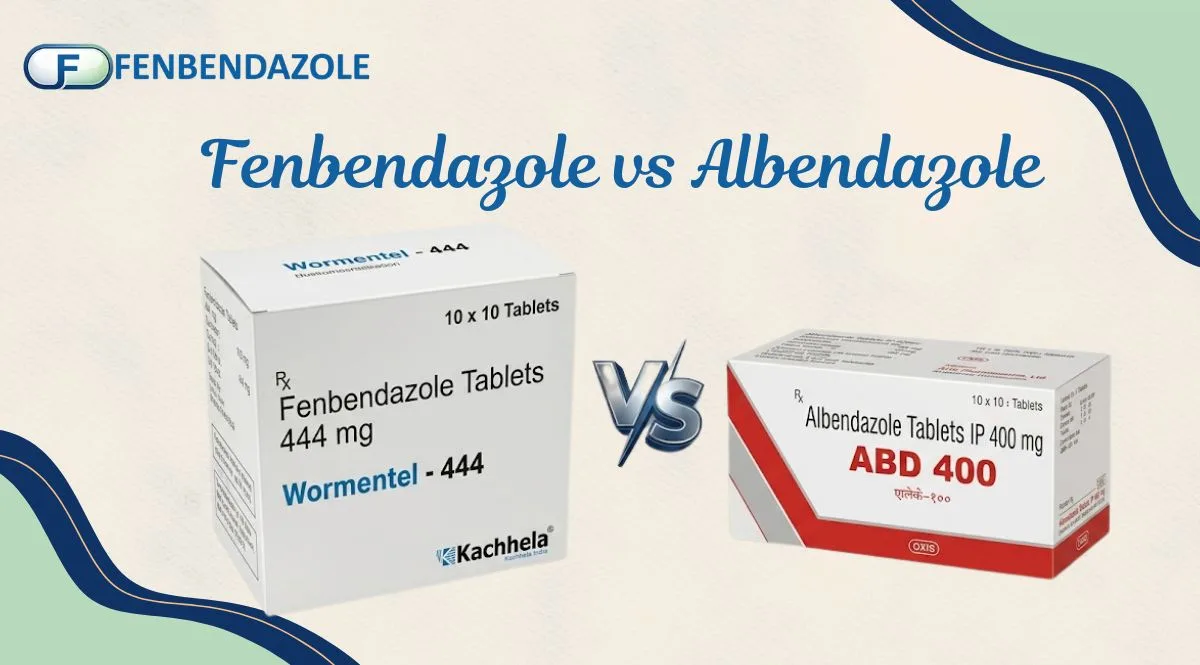
For people researching for treating parasitic worm infections, the comparison of Fenbendazole vs Albendazole is very common. They are both in the benzimidazole family, yet they are separate medications used for different things.
The main difference between the two compounds is Albendazole is an established anti-parasitic medication for humans. On the other hand, Fenbendazole is predominantly for veterinary use and has no FDA approved indication for human use.
Key Takeaways – Fenbendazole vs Albendazole
- They are both benzimidazole antiparasitic drugs.
- Fenbendazole is for veterinary use.
- Albendazole is for humans.
- Both medications interact with and inhibit parasitic microtubules.
- They do not treat the same infections.
- Fenbendazole should not be used in place of Albendazole for humans.
What Is Fenbendazole?
Fenbendazole is an antiparasitic medication for veterinary use. It is used in controlling parasites of the gastrointestinal tract in veterinary practice, for susceptible roundworms and hookworms, and whipworms among others.
Fenbendazole gained interest online because of some laboratory based research that explored its biological activities and possible relations with cancer, however, these laboratory studies should not be interpreted as approval or even use of fenbendazole for human use.
For the comparison of Fenbendazole vs Albendazole, understanding that Fenbendazole is a veterinary medication is of significance.
What Is Albendazole?
Similar to Fenbendazole, Albendazole is also an antiparasitic benzimidazole drug, but it has established use in human medicine.
In the United States, Albendazole is approved for specific parasitic conditions like neurocysticercosis and hydatid disease.
According to the World Health Organization (WHO), Albendazole is recommended for the treatment of some soil-transmitted helminthiasis, including infections caused by roundworms, whipworms and hookworms.
This provides strong evidence on the human medical side of albendazole, over fenbendazole.
Fenbendazole vs. Albendazole: Main Differences
|
Feature |
Fenbendazole |
Albendazole |
|
Drug class |
Benzimidazole |
Benzimidazole |
|
Main use |
Veterinary antiparasitic |
Human and veterinary antiparasitic |
|
FDA-approved human use |
No |
Yes, for specific conditions |
|
Human dosing |
No approved regimen |
Established for approved uses |
|
Human clinical evidence |
Limited |
Well established |
|
Veterinary use |
Yes |
Yes |
As this comparison of Fenbendazole vs. Albendazole shows, the two drugs have the same subclass, but differ in their roles in pharmacology.
How Do Fenbendazole and Albendazole Work?
Fenbendazole and Albendazole work by obstructing microtubules in susceptible parasites. Microtubules are important to the survival of the parasite, and disruption of microtubules can result in the death of the parasite.
Both drugs bind to beta-tubulin of the parasite, disrupting normal cellular processes and resulting in the death of the parasite.
Though the two drugs work similarly, Fenbendazole vs. Albendazole should not be viewed as similar drugs. They can have differences in activity, approved uses, and clinical evidence.
Which Parasites Do They Treat?
The parasites that each medicine treats is dependent on the drug, the species, and the particular infection.
There are many approved human uses of albendazole against certain helminthiasis. WHO includes albendazole in recommended treatments for helminth infections.
FBD has similarly approved uses for several worms, but primarily veterinary uses.
Fenbendazole vs. Albendazole is not a case of dealing with which drug is more effective against worms. The appropriate medicine depends on the parasite that is being treated and the patient.
Fenbendazole vs Albendazole for Humans
This is perhaps the most important distinction between the two drugs.
Albendazole has approved human indications and well-documented doses. Clinicians have a lot of experience with the drug for a variety of parasitic infections.
Fenbendazole has no approved human indications. While some websites talk about using It in humans, no evidence in the form of clinical studies done on humans can replace these claims.
Therefore, when looking at Fenbendazole vs Albendazole for humans, we should look at the available evidence and safety, in addition to the approvals.
Are Fenbendazole and Albendazole the Same?
No. The distinction between Fenbendazole vs Albendazole is about two separate active ingredients.
They do share the same broad drug family, which accounts for the similar mechanism of action. However, they have different structural formulations, different pharmacokinetic properties, different approved conditions, and different levels of clinical evidence.
Being in the same drug family does not mean they can be used interchangeably.
Fenbendazole vs Albendazole Which Is Better?
It depends.
For a human parasitic infection for which albendazole is an appropriate treatment, according to clinical evidence and approvals, albendazole should be used over Fenbendazole.
Fenbendazole has approved veterinary indications but that does not mean it can be used in place of albendazole for humans.
Fenbendazole vs Albendazole should be decided based on the parasite, patient, and approved indications and should not be based on the strength of either drug.
Fenbendazole vs Albendazole: Safety
Albendazole has a safety profile in humans that has been well documented. Side effects such as abdominal issues, headaches, nausea, and changes of liver enzymes may occur; however, treatment length and severity play a role in these occurrences.
Safety information of fenbendazole is essentially based on veterinary use. The safety and appropriate dosage in humans has been studied much less than that of albendazole.
This is an important factor when dealing with Fenbendazole vs Albendazole.
Can Fenbendazole Replace Albendazole?
Because of the reasons mentioned above, Fenbendazole should not automatically replace albendazole.
Albendazole has human indications and approved treatment processes. Fenbendazole does not have an FDA-approved human dosing process
If someone believes they have a parasitic infection, it becomes valuable to identify the parasite because certain infections could warrant different treatments.
Fenbendazole vs Albendazole for Cancer
In addition to the interest in cancer research, one of the leading reasons searchers are interested in Fenbendazole vs Albendazole is because of the anticancer activities of fenbendazole.
Although fenbendazole has shown promise in certain laboratory and preclinical studies, activates in laboratory studies cannot warrant the use of fenbendazole as an anti-cancer drug in clinical studies.
Albendazole is not an anti-cancer drug, and its primary use is in anti-parasitic treatments.
Neither drug should be used as a proven cancer treatment due to laboratory studies.
Final Words
The two drugs, fenbendazole and albendazole are similar in many respects but also can be differentiated. These drugs belong to the group of benzimidazoles and infections due to susceptible parasites are controlled by these drugs in similar ways.
In human use, the primary difference is that fenbendazole is a veterinary medicine with no FDA-approved indication for human use, while albendazole has an approved human use and clinical evidence.
For fenbendazole vs albendazole, the parasite, the evidence of approved use, the dose, the safety information, and the clinical evidence are more critically important than the strength of the two drugs.
Write Reviews
Leave a Comment
No Comments & Reviews