
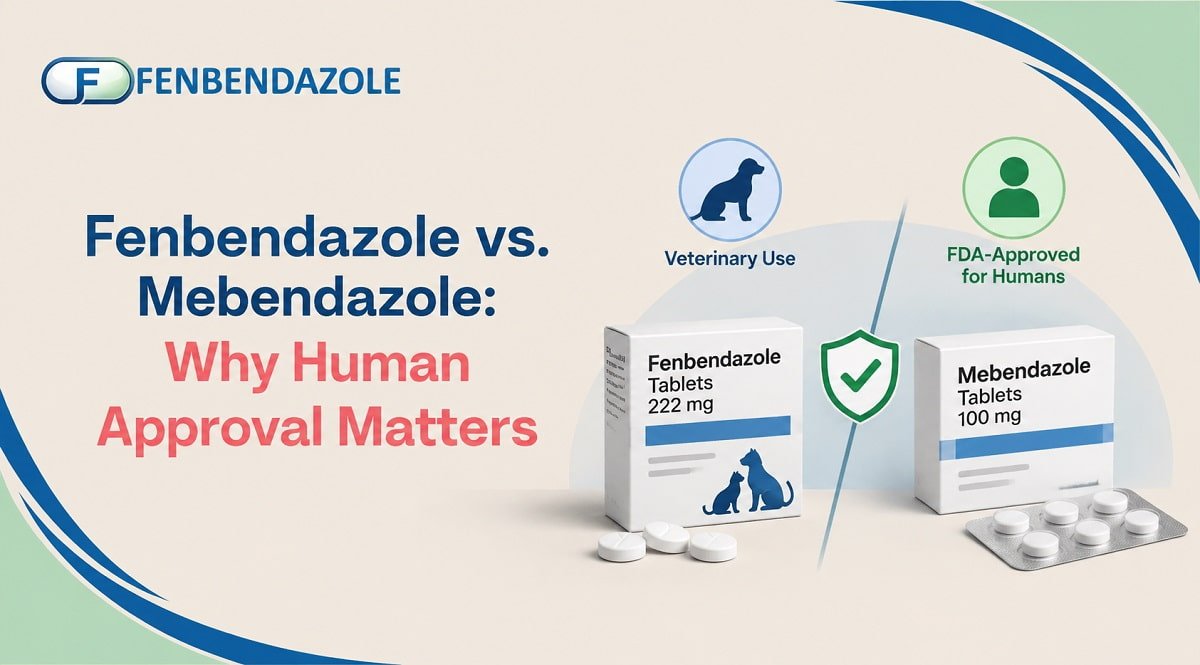
Fenbendazole vs Mebendazole may sound almost identical, but they have an important difference that anyone researching antiparasitic medications should understand. While both belong to the same family of drugs and work against certain parasitic worms, their approved uses, safety information, and medical applications are not the same.
Mebendazole is an FDA-approved medication used to treat specific intestinal worm infections in humans. Fenbendazole, on the other hand, is a veterinary antiparasitic medication that has not received FDA approval for human use in the United States.
Interest in fenbendazole for humans has grown through online health discussions, scientific research, and conversations about potential drug repurposing. This has led many people to wonder whether fenbendazole and mebendazole work in the same way, whether one is safer, and why their regulatory status differs.
Understanding these differences can help readers separate established medical evidence from experimental findings and online claims.
What Is the Difference Between Fenbendazole vs Mebendazole?
Fenbendazole and mebendazole belong to a class of medications known as benzimidazoles. These compounds interfere with important cellular functions in susceptible parasitic worms.
Although the two drugs have similar mechanisms of action, they are not interchangeable.
Fenbendazole is primarily used in veterinary medicine to treat certain parasitic infections in animals. Mebendazole has established human medical applications and is approved by the FDA for specific intestinal worm infections.
The most significant difference is the amount of reliable human clinical evidence available for each medication.
Fenbendazole vs Mebendazole Comparison Table
| Feature | Fenbendazole | Mebendazole |
|---|---|---|
| Drug classification | Benzimidazole antiparasitic | Benzimidazole antiparasitic |
| Primary use | Veterinary medicine | Human medicine |
| FDA-approved for humans | No | Yes |
| Common applications | Certain parasitic worms in animals | Certain intestinal worms in humans |
| Human clinical evidence | Limited | Established for approved uses |
| Human dosage guidelines | No FDA-approved regimen | FDA-approved prescribing instructions |
| Cancer treatment approval | No | No |
| Safety information | Limited human data; liver injury reports | Known side effects and established precautions |
| Availability in the USA | Veterinary formulations | Prescription human medication |
Both medications may share certain biological properties, but that does not mean they offer the same benefits or carry the same risks in humans.
What Is Fenbendazole and How Does It Work?
- Fenbendazole is a broad-spectrum veterinary antiparasitic medication used to manage certain worm infections in animals.
- It is commonly found in veterinary products used for dogs, livestock, and other animals. Some well-known veterinary product names include Panacur and Safe-Guard, although formulations and approved uses vary.
- Fenbendazole works by interacting with beta-tubulin, a protein involved in forming microtubules.
- Microtubules are structures that support essential cellular functions. When fenbendazole disrupts these structures in susceptible parasites, it interferes with their normal biological processes.
- Over time, this can prevent the parasites from surviving.
Why Are People Interested in Fenbendazole for Human Use?
- In recent years, fenbendazole has attracted attention beyond veterinary medicine.
- One reason is the growing interest in drug repurposing, where researchers investigate whether an existing medication might have applications beyond its original purpose.
- Some laboratory studies have examined fenbendazole’s effects on cancer-related cellular processes.
- These findings have generated online discussions about possible human applications.
- However, laboratory research does not establish that a substance is safe or effective in humans.
- A drug that produces a particular result in a laboratory may behave differently in the human body because of absorption, metabolism, drug interactions, and other biological factors.
- As of October 2026, fenbendazole is not FDA-approved for treating any human medical condition.
What Is Mebendazole and What Is It Used For?
- Mebendazole is an antiparasitic medication used to treat certain intestinal worm infections in humans.
- In the United States, an FDA-approved prescription product called Emverm contains mebendazole.
- It is indicated for specific gastrointestinal worm infections in adults and children aged two years and older.
- These include pinworm, roundworm, whipworm, and certain hookworm infections.
Common Human Uses of Mebendazole
| Parasitic infection | Common symptoms |
|---|---|
| Pinworm infection | Anal itching, particularly at night |
| Roundworm infection | Abdominal discomfort and digestive problems |
| Whipworm infection | Diarrhea, abdominal pain, and digestive symptoms |
| Hookworm infection | Blood loss, fatigue, and iron-deficiency anemia |
Mebendazole works by interfering with cellular processes that susceptible parasitic worms need to survive.
Its FDA-approved labeling provides healthcare professionals with information about its approved uses, precautions, drug interactions, and potential adverse effects.
However, mebendazole is not appropriate for every parasitic infection.
A healthcare professional may recommend different treatments depending on the specific parasite and the patient’s medical circumstances.
Why Is Mebendazole FDA-Approved but Fenbendazole Is Not?
- One of the most important questions in the fenbendazole vs mebendazole for humans comparison is why these medications have different FDA approval statuses.
- The U.S. Food and Drug Administration evaluates medications based on scientific evidence supporting their safety, effectiveness, and quality for specific medical uses.
- This evaluation can include clinical trial results, potential adverse reactions, manufacturing information, and other important evidence.
- Mebendazole has received FDA approval for certain human intestinal worm infections.
- Fenbendazole has not received FDA approval for human use.
Does That Mean Fenbendazole Is Dangerous?
- Lack of FDA approval does not automatically prove that a substance will harm everyone who takes it.
- However, it means the FDA has not established that fenbendazole has an acceptable balance of benefits and risks for any human medical indication.
- There is also no FDA-approved human dosage regimen.
- This leaves important questions unanswered about human safety, effectiveness, interactions, and long-term effects.
- The fact that a medication has established veterinary applications does not mean it is appropriate for people.
Why Does Human Approval Matter?
- FDA approval helps healthcare professionals understand how a medication should be used for a particular medical condition.
- It provides information about approved indications, known risks, precautions, and appropriate prescribing instructions.
- Without sufficient human clinical evidence, treatment decisions may rely on incomplete information.
- That is why the difference between veterinary approval and human approval is significant.
Is Fenbendazole Safe for Humans?
- The question “Is fenbendazole safe for humans?” is frequently raised in discussions about antiparasitic drugs.
- Currently, there is insufficient clinical evidence to establish fenbendazole as a safe and effective medication for human treatment.
- Although it has established uses in animals, its complete safety profile in humans remains uncertain.
- Published medical case reports have associated fenbendazole self-administration with liver injury.
- The National Institutes of Health’s LiverTox database discusses reports of clinically apparent liver injury linked to human fenbendazole exposure.
- These reports are important because they show that veterinary medications may carry serious risks when used outside their intended applications.
Fenbendazole Side Effects in Humans
Because human clinical research is limited, the complete range and frequency of fenbendazole side effects in humans are not established.
However, reported liver injury raises concerns.
Potential warning signs of liver problems include:
-
Yellowing of the skin or eyes
-
Dark-colored urine
-
Persistent nausea
-
Unusual fatigue
-
Abdominal discomfort
-
Loss of appetite
Anyone experiencing these symptoms after taking a medication or supplement should seek prompt medical evaluation.
The absence of extensive human safety data should not be interpreted as evidence that fenbendazole is harmless.
What Are the Side Effects of Mebendazole?
- Mebendazole has an established human safety profile for its approved uses, but it can still cause adverse reactions.
- Commonly reported side effects include abdominal discomfort, diarrhea, nausea, and other gastrointestinal symptoms.
- Rare but potentially serious reactions have also been reported.
- These include certain blood disorders, severe skin reactions, and liver-related complications.
- Some risks may depend on treatment duration, exposure, other medications, and individual health factors.
- Patients should follow their healthcare professional’s instructions and the applicable prescribing information.
Fenbendazole vs Mebendazole: Which Has Better Human Safety Evidence?
- Mebendazole has substantially more established human clinical evidence for its approved indications.
- Fenbendazole has limited human safety information and no FDA-approved human applications.
- This does not mean mebendazole is completely risk-free.
- It means medical professionals have more reliable evidence to guide its appropriate use in humans.
Fenbendazole vs Mebendazole for Cancer: What Does the Research Say?
- Cancer research has contributed to growing public interest in both medications.
- Scientists sometimes investigate existing medications to determine whether they might affect biological pathways involved in cancer.
- This process is known as drug repurposing.
- Both fenbendazole and mebendazole have been studied in experimental settings involving cancer-related mechanisms.
- However, there is a significant difference between early research findings and clinically proven cancer treatments.
Fenbendazole and Cancer Research
- Some laboratory and animal studies have investigated how fenbendazole affects cancer-related cellular processes.
- These studies have generated scientific interest, but they do not establish clinical effectiveness in humans.
- The American Cancer Society explains that there is no reliable clinical evidence demonstrating that fenbendazole safely and effectively treats cancer in people.
- Online success stories cannot replace controlled clinical research.
- For example, a person sharing a positive outcome may also have received chemotherapy, immunotherapy, radiation, surgery, or other treatments.
- Without properly designed studies, researchers cannot determine whether fenbendazole contributed to the outcome.
Mebendazole and Cancer Research
- Mebendazole has also attracted attention as a possible candidate for drug repurposing.
- Researchers have explored its effects on microtubules and other biological processes associated with cancer cell growth.
- Some studies have examined whether these mechanisms could have potential therapeutic applications.
- However, mebendazole’s approval for intestinal worm infections does not mean it is approved to treat cancer.
- Neither fenbendazole nor mebendazole is FDA-approved for cancer treatment.
- Patients should discuss experimental medications with their oncology team rather than replacing established treatment with unproven alternatives.
Can Humans Take Veterinary Fenbendazole?
- Veterinary fenbendazole products should not be used as substitutes for FDA-approved human medications.
- Animal medications are developed and labeled for particular species and veterinary conditions.
- Their formulations, concentrations, and inactive ingredients may differ from those used in human pharmaceutical products.
- Additionally, veterinary product instructions do not provide validated guidance for human treatment.
- Someone who suspects a parasitic infection should seek medical evaluation.
- Identifying the specific parasite is important because different infections may require different medications.
- Self-treatment with veterinary products can delay appropriate diagnosis and expose people to unnecessary risks.
Are Fenbendazole and Mebendazole Interchangeable?
- No. Fenbendazole and mebendazole are different medications, even though they belong to the same drug family.
- They have different regulatory approvals, formulations, and levels of human clinical evidence.
- A veterinary medication cannot automatically replace a medication approved for people.
- Similarly, mebendazole should not be assumed to work against every parasitic infection.
- Treatment decisions should be based on a confirmed or clinically suspected diagnosis and appropriate medical guidance.
How to Evaluate Fenbendazole Information Online?
- With so much health information available online, it can be difficult to distinguish credible research from unsupported claims.
- When reading about fenbendazole for human use, consider the type of evidence being presented.
- A laboratory experiment, an animal study, a human clinical trial, and an individual testimonial provide different levels of evidence.
- It is also important to check whether a source clearly explains the medication’s regulatory status.
- Reliable medical information should acknowledge uncertainty, explain potential risks, and avoid promising guaranteed results.
- For readers in the United States, the FDA, CDC, National Institutes of Health, and American Cancer Society are useful starting points.
FAQ About Fenbendazole vs. Mebendazole
1. What is the main difference between fenbendazole and mebendazole?
The main difference is their approved medical use. Fenbendazole is a veterinary antiparasitic medication, while mebendazole is FDA-approved for treating certain intestinal worm infections in humans.
2. Is fenbendazole FDA-approved for humans in the United States?
No. Fenbendazole is not FDA-approved for human use in the United States as of October 2026.
3. Is mebendazole safer than fenbendazole for humans?
Mebendazole has more established human safety evidence for its approved uses. Fenbendazole lacks FDA-approved human indications and sufficient clinical evidence to establish its safety for routine human treatment.
4. Can fenbendazole cause liver damage in humans?
Published medical reports have associated fenbendazole self-administration with liver injury. The frequency and full extent of these risks remain uncertain.
5. Can fenbendazole and mebendazole treat cancer?
Neither medication is FDA-approved to treat cancer. Both have attracted scientific research interest, but experimental findings do not establish them as proven cancer treatments.
6. Why is fenbendazole not approved for human use?
Fenbendazole has not undergone the FDA review necessary to establish its safety and effectiveness for a human medical indication.
7. Can humans use fenbendazole instead of mebendazole?
No. Veterinary fenbendazole should not be substituted for an approved human antiparasitic medication. A healthcare professional should determine the appropriate treatment.
8. What is an FDA-approved deworming medicine for humans?
Mebendazole is one FDA-approved option for certain intestinal worm infections. Other medications may be appropriate depending on the parasite and individual medical circumstances.
Final Thoughts: Why Human Approval Matters?
The comparison between fenbendazole and mebendazole highlights an important principle in medicine: two medications can belong to the same drug family without having the same approved uses, clinical evidence, or safety profile.
Fenbendazole has established applications in veterinary medicine, but its safety and effectiveness for human treatment have not been established through FDA approval.
Mebendazole, by comparison, has an established role in treating certain human intestinal worm infections.
While researchers continue exploring possible new applications for existing medications, early laboratory findings should not be confused with proven human treatments.
For anyone researching antiparasitic medications, the most reliable approach is to understand the available scientific evidence, recognize the limitations of experimental research, and consult qualified healthcare professionals before making treatment decisions.
Medical References
Medical Disclaimer: This article is intended for educational purposes only. It does not provide medical advice, recommend veterinary medications for human use, or endorse experimental cancer treatments. Always consult a qualified healthcare professional for diagnosis and treatment decisions.
Write Reviews
Leave a Comment
No Comments & Reviews